
Michaux-Perreaux Steam Vélocipède (1867–1869)
The Michaux-Perreaux Steam Vélocipède (1867–1869) — one of the world's first motorcycles, built by attaching a Perreaux steam engine to a Michaux
🚲💨 Michaux-Perreaux Steam Vélocipède (1867–1869)
The First Steam-Powered Motorcycle — Born in Paris
When Louis-Guillaume Perreaux's alcohol-fueled steam engine met Pierre Michaux's iron-framed boneshaker bicycle, the result was one of the world's first motorcycles — a machine so revolutionary it entered the Guggenheim Museum a century later as the opening exhibit of "The Art of the Motorcycle."
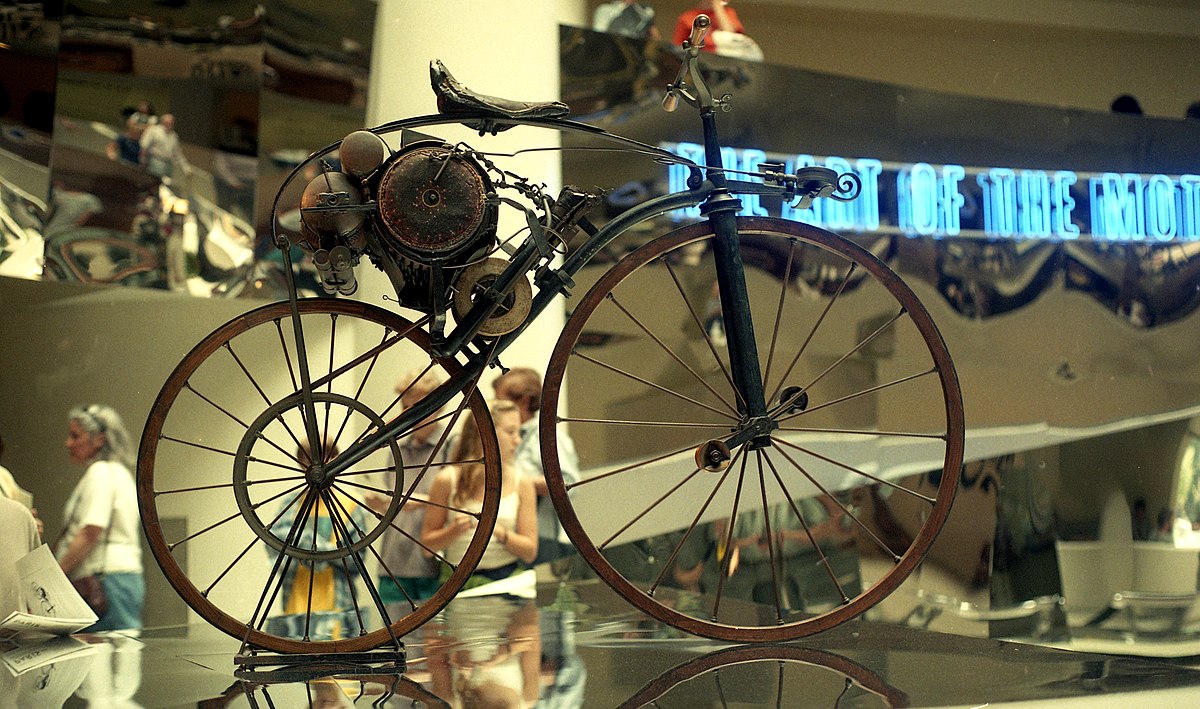
📷 Wikimedia Commons · License: CC BY-SA 3.0
📋 Overview & Identification Card
The Michaux-Perreaux steam vélocipède was a steam-powered motorcycle made in Paris, France sometime between 1867 and 1871. It combined a small commercial steam engine designed by Louis-Guillaume Perreaux (1816–1889) with an iron-framed pedal bicycle manufactured by Pierre Michaux's company, Michaux et Cie. It is one of three machines claimed to be the world's first motorcycle, along with the Roper steam velocipede (USA, c. 1867–1869) and the Daimler Reitwagen (Germany, 1885).
Ernest Michaux (c. 1842–1882), Pierre's son, is credited by historians L.J.K. Setright and David Burgess-Wise as having first fitted the Perreaux engine to the velocipede. Only one example was ever built. The surviving original is preserved at the Musée de l'Île-de-France, Sceaux, near Paris.
🗂️ Michaux-Perreaux Steam Vélocipède — Identification Card
| Full Name | Michaux-Perreaux Steam Vélocipède |
| Also Known As | Vélocipède à Vapeur Perreaux; "La Perreaux" |
| Year Built | c. 1867–1871 (debated) |
| Engine Designer | Louis-Guillaume Perreaux (1816–1889), French inventor & engineer |
| Base Vehicle | Michaux boneshaker bicycle (iron serpentine frame) |
| Vehicle Builder | Pierre Michaux (1813–1883) / Michaux et Cie, Paris |
| Integration Credit | Ernest Michaux (c. 1842–1882) — per Setright & Burgess-Wise |
| Patent | 26 December 1869 — Perreaux steam velocipede patent (France) |
| Patent Addendum | 14 June 1871 — removal of cranks/pedals; arched downtube |
| US Patent | 12 March 1872 — improved steam velocipede (US patent digest) |
| Engine | Single-cylinder, alcohol-fueled steam engine |
| Engine Weight | 62 kg (137 lb) |
| Total Weight | 87–88 kg (192–194 lb) |
| Drive | Twin flexible leather belt drives to rear wheel |
| Brakes | None (base Michaux had spoon brake, removed on steam version) |
| Steering | Handlebars (direct) |
| Wheels | Wooden spoked wheels with iron tires |
| Controls | Steam pressure gauge (above front wheel); hand control (steam regulation) |
| Units Built | 1 (unique prototype) |
| Original Location | Musée de l'Île-de-France, Sceaux, near Paris |
| Major Exhibitions | Guggenheim Museum, New York (1998); Guggenheim Las Vegas (2001); QAGOMA, Brisbane (2021) |
| Later Development | Perreaux exhibited a tricycle version by 1884 at the Champs-Élysées Industrial Exhibition |
| Significance | One of the world's first motorcycles; strongest patent-backed claim for first steam motorcycle |
📸 1861–1868: Ernest Michaux & the Michaudine Velocipede
Inventor & Invention Photography

📷 Wikimedia Commons · Public Domain (pre-1931 publication)

📷 Wikimedia Commons · Public Domain
👨👦 The Michaux Family — Inventors of the Bicycle
"The simplest way to define a motorcycle is as a bicycle propelled by a heat engine; and if we accept this we must go on to admit that its prototype is unidentifiable, shrouded in the mists of industrial antiquity."— L.J.K. Setright, The Guinness Book of Motorcycling Facts and Feats (1979)
Pierre Michaux (1813–1883)
| Born | 25 June 1813, Bar-le-Duc, Meuse, France |
| Died | 10 January 1883, France |
| Occupation | Blacksmith (serrurier / locksmith) — furnished parts for the carriage trade in Paris |
| Known For | Adding pedals to a draisine to create the Michaudine velocipede — the forerunner of the modern bicycle |
| Company | Michaux et Cie (founded 7 May 1868 with the Olivier brothers) |
| Address | 19 Rue Jean-Goujon, Paris (later extended to No. 27) |
Ernest Michaux (c. 1842–1882)
| Born | c. 1842 (some sources say 1849), France |
| Died | c. 1882, France |
| Occupation | Mechanic, bicycle builder, son of Pierre Michaux |
| Known For | Possibly the true inventor of the pedal bicycle; credited with first fitting the Perreaux steam engine to a Michaux vélocipède |
| Legacy | Henri Michaux (brother) claimed Pierre conceived the idea, but Ernest executed it |
The Invention Controversy
Pierre Michaux was born in Bar-le-Duc and worked as a blacksmith making parts for the carriage trade in Paris during the 1850s and 1860s. He, or his son Ernest, adapted cranks and pedals to the front wheel of a draisine (a two-wheeled vehicle pushed by feet), creating the Michaudine velocipede — the forerunner of every bicycle in the world today.
The Encyclopaedia Britannica states the best evidence places the invention in Paris in early 1864, not 1861 or 1855 as stated in many older histories. However, the famous photograph (Image 1) caption states 1861. Henri Michaux, another son, claimed that Pierre conceived the idea but Ernest executed it. A competing claim exists from Pierre Lallement, a carriage maker from Nancy who emigrated to America and filed the only patent for the pedal bicycle.
🚲 The Michaudine Velocipede — The Base Machine
The Michaudine was the common name for the pedal-driven velocipede (also called the "boneshaker") mass-produced by Michaux et Cie in Paris from the 1860s. It was the first commercially mass-produced pedal bicycle in history — with over 400 units built annually by 1863.
Company History: Michaux et Cie
In 1868, Pierre Michaux formed a partnership with the Olivier brothers (René and Aimé) under his own name: Michaux et Cie. The Oliviers held a 69% share. The company moved from Avenue Montaigne 29 to a new factory at 19 Rue Jean-Goujon, near the Arc de Triomphe, which was later extended to No. 27 and 10/12 Avenue Bugeaud. Machines were advertised at prices from Fr. 200–400, with juvenile machines from Fr. 120.
Following a trading dispute with the Olivier brothers in 1869, Michaux sold his share and the partnership was dissolved on 17 April 1869. The Oliviers then formed Compagnie Parisienne des Vélocipèdes. Pierre Michaux and his company faded into obscurity as the first bicycle craze ended in France.
Design Evolution
- Early design (1861–1864): Wooden frame adapted from a draisine; cranks and pedals on the front wheel
- Serpentine frame (1865–1867): Two pieces of cast iron bolted together (45 kg); more elegant but fragile
- Diagonal frame (1867+): Single diagonal piece of wrought iron (designed by Gabert of Lyon, 1865); much stronger
- Improvements (1868): Cord-operated brake and acorn pedals (patent 80637, 24 April 1868)
- Wheels: Wood with iron tires (like horse-drawn carriages)
📍 Michaux et Cie Factory Location — Paris
📰 Gallery: Advertisements & Price Lists (1869)
From Almanach des Vélocipèdes Illustré, 1869

📷 Wikimedia Commons · Public Domain

📷 Wikimedia Commons · Public Domain
🔧 Louis-Guillaume Perreaux — The Engine Builder
Louis-Guillaume Perreaux (1816–1889)
| Born | 19 February 1816, Almenêches, Orne, France |
| Died | 5 April 1889, Paris, France |
| Occupation | Inventor, engineer |
| Known For | Building the steam engine for the Michaux-Perreaux steam vélocipède — one of the world's first motorcycles |
| Patent (France) | 26 December 1869 — Steam velocipede |
| Patent Addendum | 14 June 1871 — Removal of cranks/pedals; arched downtube |
| Later Work | Exhibited a steam tricycle at the 1884 Industrial Exhibition, Champs-Élysées, Paris |
Louis-Guillaume Perreaux showed early interest in mechanical engineering and devoted his career to developing compact steam engines for personal transport. He built a small, remarkably compact single-cylinder alcohol-fueled steam engine that he attached to a Michaux iron-framed boneshaker bicycle sometime between 1867 and 1871. He patented the design on 26 December 1869.
Classic Bike editor Hugo Wilson argues that because the Michaux-Perreaux has patents to verify its date, it has a stronger claim on being the first motorcycle than the Roper steam velocipede, which was never patented. Perreaux continued development and by 1884 exhibited a tricycle version at the Industrial Exhibition on the Champs-Élysées, Paris, with a speed of 15–18 mph (24–29 km/h) and a range of 30–54 miles (48–87 km).
🛠️ Development of the Steam Vélocipède
The Michaux-Perreaux steam vélocipède was constructed using the first commercially successful pedal bicycle — a Michaux boneshaker which Michaux had been building over 400 of annually since 1863 — and the single-cylinder alcohol-fueled Perreaux engine, which used twin flexible leather belt drives to the rear wheel.
Key Design Features
- Steam pressure gauge mounted in the rider's view above the front wheel
- Hand control to engage and regulate steam to the cylinder
- No brakes — the base Michaux vélocipède came with a spoon brake, but the steam version had none
- Engine weight: 62 kg (137 lb); total vehicle: 87–88 kg (192–194 lb)
- Wooden wheels with iron tires, flimsy handlebars, and a high seat "perched precariously above the boiling steam engine"
1871 Patent Addendum
A 14 June 1871 addition to Perreaux's original patent included significant changes: the removal of cranks and pedals from the front wheel (making it a pure motor vehicle rather than a hybrid pedal/motor machine), and using an arched instead of straight downtube to allow space for the engine. Although the steam vélocipède was functional, it did not have any commercial successors.
1884 Tricycle Development
By 1884, Perreaux exhibited a tricycle version with two rear wheels and belt driving the front wheel at the Industrial Exhibition on the Champs-Élysées, Paris. The alcohol-fueled engine had similar bore and stroke to the original, developing 3½ atm (250 kPa) steam pressure in its 2.8-liter boiler, producing a speed of 15–18 mph (24–29 km/h). Water tanks were sufficient for 2–3 hours of operation, giving a range of 30–54 miles (48–87 km).
📐 Technical Specifications
📐 Michaux-Perreaux Steam Vélocipède — Complete Specifications
| Vehicle Type | Steam-powered two-wheeled vélocipède (motorcycle) |
| Engine Type | Single-cylinder alcohol-fueled steam engine |
| Engine Designer | Louis-Guillaume Perreaux |
| Fuel | Alcohol (denatured spirits) |
| Boiler | Compact boiler with steam pressure gauge |
| Drive | Twin flexible leather belt drives to rear wheel |
| Engine Weight | 62 kg (137 lb) |
| Total Weight | 87–88 kg (192–194 lb) |
| Frame | Iron serpentine frame (Michaux boneshaker) |
| Wheels | Wooden spoked with iron tires |
| Brakes | None (base model had spoon brake, removed) |
| Steering | Handlebars (direct) |
| Controls | Steam pressure gauge (above front wheel); hand control (steam regulation) |
| Seat | High-mounted saddle above engine |
📐 1884 Perreaux Steam Tricycle — Later Development Specs
| Layout | Tricycle — two rear wheels, belt-driven front wheel |
| Steam Pressure | 3½ atm (250 kPa) |
| Boiler Capacity | 3 US qt (2.8 L) |
| Top Speed | 15–18 mph (24–29 km/h) |
| Operating Time | 2–3 hours |
| Range | 30–54 miles (48–87 km) |
| Exhibition | 1884 Industrial Exhibition, Champs-Élysées, Paris |
🖼️ Gallery: The Michaux-Perreaux Steam Vélocipède
The Only Surviving Original — Multiple Views
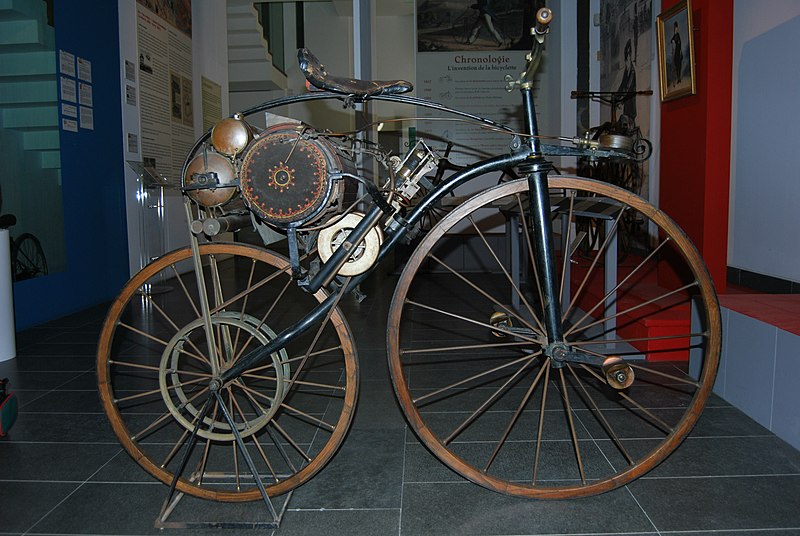
📷 Wikimedia Commons · CC BY-SA 3.0

📷 Wikimedia Commons · CC BY-SA 3.0

📷 Wikimedia Commons · CC BY-SA 3.0

📷 Wikimedia Commons · CC BY-SA 3.0
📍 Home Museum: Musée de l'Île-de-France, Sceaux
🤔 The "First Motorcycle" Debate
"History follows things that succeed, not things that fail."— Kevin Cameron, Technical Editor, Cycle World
Three machines compete for the title of "world's first motorcycle":
🏆 Three Contenders for "First Motorcycle"
| Michaux-Perreaux | France, c. 1867–1869 — Steam — Patent: 26 Dec 1869 |
| Roper Steam Velocipede | USA, c. 1867–1869 — Steam — No patent filed |
| Daimler Reitwagen | Germany, 1885 — Gasoline ICE — Patent: DE 36423 |
Arguments for the Michaux-Perreaux
- Earliest patent: Perreaux patented his design on 26 December 1869, giving it verifiable documentation that the Roper lacks
- Hugo Wilson (Classic Bike): "Because the Perreaux-Michaux has patents to verify its date, it has a stronger claim on being first than the Roper"
- If the definition of motorcycle is "a bicycle propelled by a heat engine" (L.J.K. Setright), both steam machines qualify
- Predates the Daimler Reitwagen by 16–18 years
Arguments Against
- Kevin Cameron (Cycle World) rejects steam cycles: "A true motorcycle must use a gasoline internal combustion engine"
- The Reitwagen was "the prototype for virtually all successful designs that followed"
- Steam was a "dead end" technology — no production steam motorcycles followed
- The Oxford English Dictionary includes an internal combustion engine as a criterion for "motorcycle"
The Resolution
Glynn Kerr (Motorcycle Consumer News) offers a compromise: calling the Reitwagen "the predecessor of all gasoline-driven vehicles on land, sea, or air" — but not a true motorcycle because it used outrigger wheels and could not lean. The Michaux-Perreaux and Roper were true two-wheelers. Regardless of which side one takes, the first production motorcycle — the Hildebrand & Wolfmüller of 1894 — used an internal combustion engine, making that question settled.
📜 Gallery: Michaux Boneshaker & Patent Documents
1870: Michaux Boneshaker

📷 Wikimedia Commons · Public Domain
1872: US Patent Documents

📷 Wikimedia Commons · Public Domain

📷 Wikimedia Commons · Public Domain
1884: Technical Reference

📷 Wikimedia Commons · Public Domain
🏛️ Gallery: Museum Specimens Worldwide
Musée des Arts et Métiers, Paris
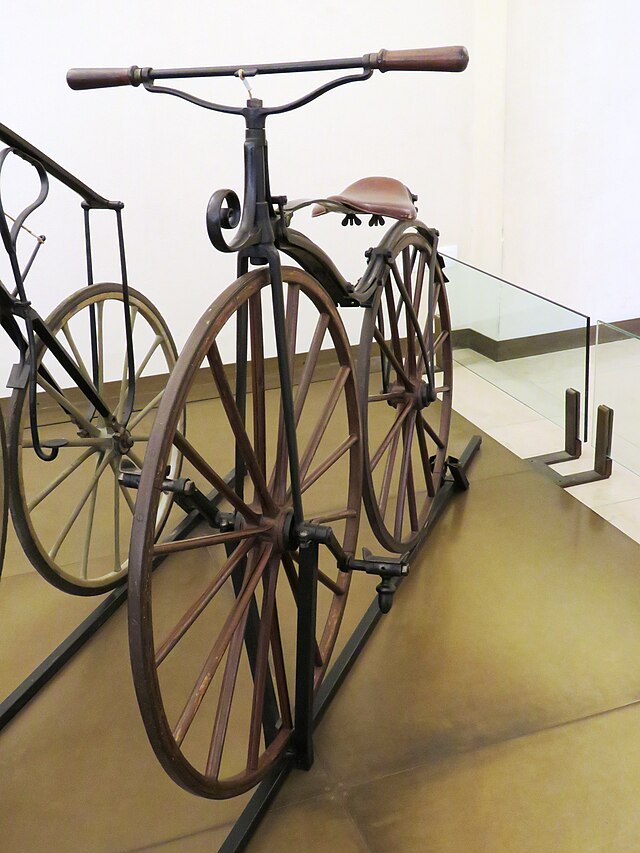
📷 Wikimedia Commons · CC BY-SA 4.0
Museo Napoleonico, Rome & Science Museum, London

📷 Wikimedia Commons · CC BY-SA 3.0

📷 Wikimedia Commons · CC BY-SA 3.0
Vélo Michaux 1861

📷 Wikimedia Commons · CC BY-SA 3.0
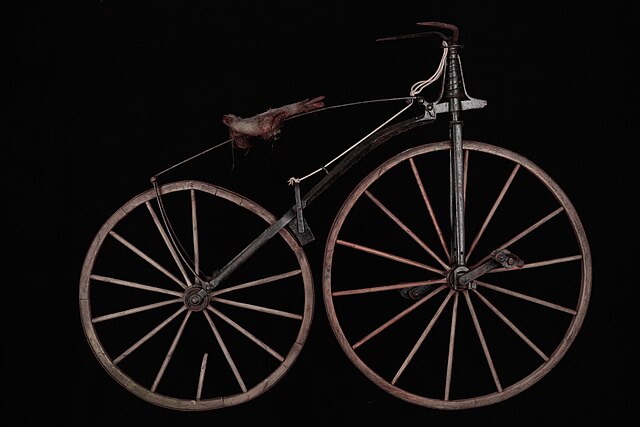
📸 Gallery: Vélocipède Michaux Photo Series (7 Views)
Multi-angle photographic series by photographer tetedelacourse, May 2008. A comprehensive documentation of a surviving Michaux velocipede:


🏷️ Gallery: Badge, Memorial & Reproductions

📷 Wikimedia Commons · CC BY-SA 3.0

📷 Wikimedia Commons · CC BY-SA 4.0
Reproduction & Exhibition

📷 Wikimedia Commons · CC BY-SA 4.0

📷 Wikimedia Commons · CC BY-SA 3.0
📅 Timeline: Key Dates (1813–1894)
📖 Primary Scientific References
- Wikipedia — "Michaux-Perreaux steam velocipede." en.wikipedia.org
- Wikipedia — "Pierre Michaux." en.wikipedia.org
- Wikipedia — "Roper steam velocipede." en.wikipedia.org
- Encyclopaedia Britannica — "Ernest Michaux: French inventor." britannica.com
- Setright, L.J.K. (1979). The Guinness Book of Motorcycling Facts and Feats. Guinness Superlatives. ISBN 0-85112-200-0.
- Wilson, Hugo — Editor, Classic Bike. Analysis of first motorcycle patent claims.
- Cameron, Kevin — Technical Editor, Cycle World. "History follows things that succeed, not things that fail."
- Kerr, Glynn — Design Columnist, Motorcycle Consumer News. Analysis of first motorcycle definitions.
- Falco, Charles M. — Motorcycling historian. Dating and attribution analysis.
- Burgess-Wise, David — Motoring historian. Dating, attribution, and Reitwagen critique.
- Baudry de Saunier, L. — Le Cyclisme théorique et pratique (source of Ernest Michaux portrait).
- Perreaux Steam Engine Patent (26 December 1869, France). Addendum: 14 June 1871.
- US Patent Digest — Digest of United States Automobile Patents from 1789 to July 1, 1899, p. 37.
- Knight, Edward H. (1884). Knight's New Mechanical Dictionary. Steam velocipede entry.
- Online Bicycle Museum — "1867 Michaux Serpentine Velocipede." onlinebicyclemuseum.co.uk
- DMG-Lib — "Perreaux, Louis Guillaume (1816–1889)." dmg-lib.org
- The Vintagent — "The Motorcycle is 200 Years Old Today?" (2018). thevintagent.com
- QAGOMA — "Perreaux Steam Velocipede / 'The Motorcycle' Virtual Tour" (2021). YouTube
- Wikimedia Commons — All images: Public Domain or Creative Commons licensed. Category: Michaux-Perreaux
❓ Frequently Asked Questions
Was the Michaux-Perreaux steam vélocipède the first motorcycle?
It is one of three machines claimed to be the first motorcycle, alongside the Roper steam velocipede (USA, c. 1867–1869) and the Daimler Reitwagen (Germany, 1885). Its claim depends on the definition — if steam-powered two-wheelers count, it rivals the Roper. If only gasoline ICE qualifies, the Reitwagen takes priority. The Michaux-Perreaux has the strongest patent-backed claim (26 December 1869).
Who built the Michaux-Perreaux steam vélocipède?
Louis-Guillaume Perreaux (1816–1889) designed the steam engine, while the base vehicle was a Michaux boneshaker bicycle. Ernest Michaux, Pierre's son, is credited by historians Setright and Burgess-Wise as having first fitted the engine to the vélocipède.
Where can I see the Michaux-Perreaux today?
The only surviving original is at the Musée de l'Île-de-France, Sceaux, near Paris. It has been loaned to the Guggenheim Museum (New York, 1998) and Guggenheim Las Vegas (2001–2003).
Who invented the Michaudine velocipede?
The Michaudine (pedal bicycle) is attributed to Pierre Michaux (1813–1883) and/or his son Ernest Michaux. Britannica places the invention in Paris in early 1864, though 1855 and 1861 have also been suggested. Pierre Lallement is another competing claimant.
What engine did the Michaux-Perreaux use?
A single-cylinder alcohol-fueled Perreaux steam engine weighing 62 kg (137 lb), with twin flexible leather belt drives to the rear wheel. Total vehicle weight: 87–88 kg (192–194 lb).
What is a Michaudine?
A "Michaudine" is the common name for the pedal-driven velocipede (boneshaker bicycle) mass-produced by Michaux et Cie in Paris from the 1860s — the first commercially mass-produced pedal bicycle in history, with over 400 units built annually by 1863.
📖 Related Articles
- → Vélocipédraisiavaporianna (1818) — The World's First Motorcycle Concept
- → Daimler Reitwagen (1885) — The First Gasoline Motorcycle
- → Roper Steam Velocipede (1867–1869) — The American Competitor
- → Hildebrand & Wolfmüller (1894) — The First Production Motorcycle
- → Complete Motorcycle History Encyclopedia Timeline (1818–2025)
