
Daimler Reitwagen (1885)
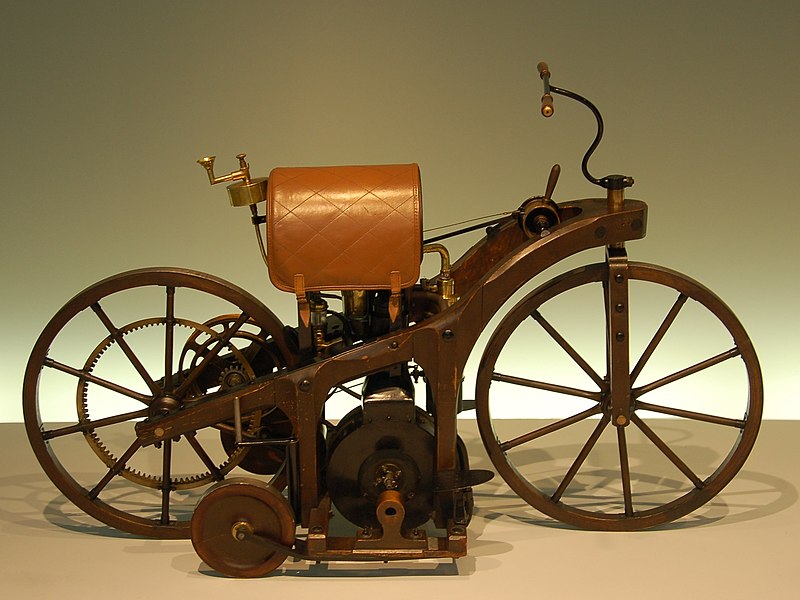
The Daimler Reitwagen (1885) — the world's first gasoline-powered motorcycle, built by Gottlieb Daimler and Wilhelm Maybach in Cannstatt, Stuttgart.

🏍️ Daimler Reitwagen (1885)
The World's First Gasoline-Powered Motorcycle
Built by Gottlieb Daimler and Wilhelm Maybach in a garden shed in Cannstatt, Stuttgart — the machine that proved the internal combustion engine could power personal transport, and accidentally invented the motorcycle.

📷 Wikimedia Commons · Source · License: CC BY-SA 3.0
📋 Overview & Identification Card
The Daimler Reitwagen (German: "riding car"), also called the Einspur ("single track"), is a motor vehicle built by Gottlieb Daimler and Wilhelm Maybach in 1885 in Cannstatt (now part of Stuttgart), Germany. It is widely recognized as the world's first gasoline-powered motorcycle and the forerunner of all vehicles — land, sea, and air — that use the internal combustion engine.
🗂️ Daimler Reitwagen — Identification Card
| Full Name | Daimler Petroleum Reitwagen (Petroleum Riding Car) |
| Also Known As | Einspur (Single Track); "Reitwagen mit Petroleum Motor" |
| Year Built | 1885 |
| Inventors | Gottlieb Daimler (1834–1900) & Wilhelm Maybach (1846–1929) |
| Built At | Experimental workshop (garden shed), Cannstatt, Stuttgart, Kingdom of Württemberg, German Empire |
| Patent | DE 36423 — "Fahrzeug mit Gas- bzw. Petroleum-Kraftmaschine" — granted 29 August 1885 |
| Engine Patent | DE 34926 — "Standuhr" (Grandfather Clock) engine — patented 3 April 1885 |
| Engine | 264 cc, single-cylinder, four-stroke Otto cycle, air-cooled |
| Power | 0.5 hp (0.37 kW) at 600 rpm |
| Top Speed | 7 mph (11 km/h) |
| First Ride | November 10 (or 18), 1885 — by Paul Daimler (age 17) |
| Route | Cannstatt to Untertürkheim, 5–12 km round trip |
| Frame | Wood (reinforced with steel), iron-tread wooden wheels |
| Wheels | 2 main + 2 spring-loaded outrigger stabilizer wheels |
| Ignition | Hot-tube ignition (platinum tube, external flame) |
| Fuel System | Float-metered carburetor, petroleum naphtha |
| Original Fate | Destroyed in the 1903 Cannstatt factory fire |
| Replicas Exist At | Mercedes-Benz Museum, Deutsches Museum, Sinsheim, Hockenheimring, PS-Speicher Einbeck, Verkehrsmuseum Dresden, KTM Motohall, Honda Collection Hall, AMA Hall of Fame, and others |
| Significance | World's first gasoline-powered motorcycle; forerunner of all ICE vehicles |
🖼️ 1883–1885: Historical Illustrations & Patent Drawing
Original Patent Drawing — DE Patent 36423, 29 August 1885

📷 Wikimedia Commons · Public Domain (patent expired)
Historical Illustrations

📷 Wikimedia Commons · Public Domain

📷 Wikimedia Commons · Public Domain
📜 Development History
"The first motorcycle looks like an instrument of torture."— Melissa Holbrook Pierson, The Perfect Vehicle
From Otto's Factory to the Garden Shed (1872–1882)
Gottlieb Daimler visited Paris in 1861 and observed the first internal combustion engine developed by Étienne Lenoir. In 1872, he became director of N.A. Otto & Cie, the world's largest engine manufacturer. Under Daimler's direction, together with his plant engineer Wilhelm Maybach, the company succeeded in creating the compressed-charge gaseous petroleum engine in 1876 — the famous Otto cycle four-stroke engine.
Otto had no interest in making engines small enough for transportation. After disputes over the direction of design, Daimler left Deutz in 1882 and took Maybach with him. Together they moved to Cannstatt (now part of Stuttgart) and founded an experimental workshop in the garden shed behind Daimler's house.
The "Grandfather Clock" Engine (1883–1884)
Their goal was to build an engine small and fast enough to power transportation. The Otto engines ran at only 150–200 rpm and could not be throttled. Daimler aimed for a minimum of 600 rpm. This was achieved in 1883 with a horizontal cylinder engine running on petroleum naphtha. The next year, they developed the vertical cylinder "Standuhr" (Grandfather Clock) engine — so named because its tall, narrow profile resembled a grandfather clock. It achieved 700 rpm, soon reaching 900 rpm, made possible by hot-tube ignition developed by an Englishman named Watson. The electrical systems of that era were too slow and unreliable for such speeds.
Building the Reitwagen (1884–1885)
Having achieved their engine goals, Daimler and Maybach needed a test bed to prove the engine's viability in a vehicle. Their engine prototype was not yet powerful enough for a full-size carriage, so they chose a two-wheeled frame. The original 1884 design featured a belt drive and a twist-grip on the handlebars — turned one way it applied the brake; turned the other way it tensioned the drive belt, applying power to the rear wheel. The plans also called for steering linkage shafts with right-angle bends connected by gears.
The actual working model used simpler handlebars without the twist grip or gear linkage. The design was patented on 29 August 1885 as DE Patent 36423, titled "Fahrzeug mit Gas- bzw. Petroleum-Kraftmaschine" (Vehicle with gas or petroleum drive machine). According to the patent specification, the vehicle could also be fitted with a skid and spikes, making it — technically — the first snowmobile as well.
⚙️ The "Grandfather Clock" Engine (Standuhr)
The engine that powered the Reitwagen was patented separately on 3 April 1885 (DE Patent 34926) and called the "Standuhr" (grandfather clock) due to its tall, narrow profile. It was the most advanced small engine in the world at that time — a revolutionary leap from the massive, stationary gas engines of the era.
⚙️ Engine Specifications
| Type | Single-cylinder, four-stroke Otto cycle |
| Displacement | 264 cc (16.1 cu in) |
| Power Output | 0.5 hp (0.37 kW) |
| Operating Speed | 600 rpm (capable of 700–900 rpm) |
| Fuel | Petroleum naphtha (ligroin / benzine) |
| Fuel System | Float-metered carburetor (Daimler/Maybach design) |
| Cooling | Air-cooled |
| Ignition | Hot-tube ignition — platinum tube heated by external open flame |
| Intake Valves | Mushroom-type atmospheric inlet valves (opened by piston suction) |
| Exhaust Valve | Mechanically operated side exhaust valve |
| Crankcase | Aluminum |
| Flywheels | Twin flywheels |
| Mounting | Mounted on rubber blocks (vibration isolation) |
| Patent | DE 34926 (3 April 1885) — "Gas- bzw. Petroleum-Kraftmaschine" |
| Could Also Run On | Coal gas |
📐 Full Technical Specifications
📐 Daimler Reitwagen — Complete Specifications
| Overall Layout | Two main wheels (in-line) + two outrigger stabilizer wheels (spring-loaded) |
| Frame | Wooden frame reinforced with steel |
| Main Wheels | Two iron-tread wooden wheels |
| Outriggers | Two spring-loaded auxiliary stabilizer wheels (like training wheels) |
| Steering | Simple handlebars (direct steering, no linkage in final version) |
| Seat | Saddle (leather) |
| Brake | Cord-operated hand brake |
| Drive (Original) | Belt drive (1884 design) |
| Drive (Winter 1885–86) | Upgraded to two-stage, two-speed transmission — belt primary + ring gear on rear wheel |
| Engine Position | Vertical, between the two main wheels, mounted on rubber blocks |
| Top Speed | 7 mph (11 km/h); some sources say up to 7.5 mph (12 km/h) |
| Weight | Approximately 90 kg (198 lb) |
| Rake & Trail | Not employed — hence the need for outrigger wheels |
🚀 The First Ride — November 1885
Daimler's 17-year-old son, Paul Daimler, made the first test ride on the Reitwagen on November 10, 1885 (some sources cite November 18). He traveled 5–12 kilometers (3.1–7.5 miles) from Cannstatt to Untertürkheim and back, on roads that were entirely unmetalled.
The ride was eventful: the seat caught fire during the journey. The hot-tube ignition system — a platinum tube heated by an external open flame — was located directly underneath the saddle. Despite the minor combustion incident, the ride proved the engine concept was viable.
"Daimler's 17-year-old son, Paul, rode it first on November 18, 1885, going 5–12 kilometres from Cannstatt to Untertürkheim. The seat caught fire on that excursion."— Wikipedia, "Daimler Reitwagen"
Over the winter of 1885–1886, the belt drive was upgraded to a two-stage, two-speed transmission with a belt primary drive and ring gear final drive on the back wheel. By 1886, the Reitwagen had served its purpose as an engine test bed and was abandoned in favor of further development on four-wheeled vehicles.
📍 First Ride Route: Cannstatt → Untertürkheim
🤔 Status as First Motorcycle — The Debate
"History follows things that succeed, not things that fail."— Kevin Cameron, Technical Editor, Cycle World
The Reitwagen's status as the first motorcycle depends on the definition. The Oxford English Dictionary defines a motorcycle as requiring an internal combustion engine, which supports the Reitwagen's claim.
Arguments For "First Motorcycle"
- First gasoline ICE two-wheeler — undisputed, even if steam predecessors exist (Perreaux 1867, Roper 1869, Copeland 1884)
- Kevin Cameron (Cycle World): "Steam power was a dead end. The Reitwagen hit upon the successful engine type."
- The OED definition uses the internal combustion criterion
- It was the Reitwagen that inspired following designs and started the motorcycle industry
Arguments Against
- It had four wheels (two main + two outriggers) — is it really a motorcycle?
- The outriggers point to a deeper issue: Daimler did not employ rake and trail, well-understood bicycle dynamics at the time
- Motoring author David Burgess-Wise called it "a crude makeshift" — "as a bicycle, it was 20 years out of date"
- Enrico Bernardi's 1884 Motrice Pia was an earlier gasoline vehicle (tricycle)
The Consensus
Most mainstream sources — including the Mercedes-Benz Museum, Deutsches Museum, Oxford English Dictionary, and Encyclopaedia Britannica — recognize the Daimler Reitwagen as the world's first gasoline-powered motorcycle. The fact that it was a test bed rather than a product does not diminish its historical significance — it proved the concept that powered the entire 20th century.
🔥 Fate of the Original & Replicas
The original Reitwagen was destroyed in the 1903 Cannstatt Fire that razed the Daimler-Motoren-Gesellschaft Seelberg-Cannstatt plant. However, several high-quality replicas (German: Nachbau) exist in museums worldwide:
🏛️ Where to See the Daimler Reitwagen Today
| 🇩🇪 Mercedes-Benz Museum | Stuttgart, Germany — The primary replica, in permanent display |
| 🇩🇪 Deutsches Museum | Munich, Germany — Lent to Guggenheim Las Vegas (2001) |
| 🇩🇪 Auto & Technik Museum | Sinsheim, Germany |
| 🇩🇪 Motor-Sport-Museum | Hockenheimring, Germany |
| 🇩🇪 PS-Speicher | Einbeck, Germany |
| 🇩🇪 Verkehrsmuseum | Dresden, Germany |
| 🇦🇹 KTM Motohall | Mattighofen, Austria — On loan from Mercedes-Benz Museum |
| 🇯🇵 Honda Collection Hall | Twin Ring Motegi, Japan |
| 🇺🇸 AMA Motorcycle Hall of Fame | Pickerington, Ohio, USA — Larger than original |
| 🇨🇦 Deeley Motorcycle Exhibition | Vancouver, Canada |
| 🇦🇺 Melbourne, Australia | Private collection |
| 🇱🇺 GRIDX Centre | Wickrange, Luxembourg (2026) |
🏛️ Gallery: Mercedes-Benz Museum, Stuttgart (7 Images)
The Mercedes-Benz Museum in Stuttgart-Untertürkheim houses the most famous replica of the Daimler Reitwagen. The museum, designed by UNStudio, opened in 2006 and documents 130+ years of automotive history.

📷 Source · CC BY-SA 3.0
📷 Source · CC BY-SA 3.0

📷 Source · CC BY-SA 3.0

📷 Source · CC BY-SA 3.0

📷 Source · CC BY-SA 3.0

📷 Source · CC BY 2.0
🏛️ Gallery: Auto & Technik Museum Sinsheim (2 Images)


🏛️ Gallery: Motor-Sport-Museum, Hockenheimring (2 Images)


🏛️ Gallery: Other Museums & Exhibitions
Verkehrsmuseum Dresden

📷 Source · CC BY-SA 4.0
PS-Speicher, Einbeck


🏆 Gallery: Replicas at Events & Various Locations


👨🔬 The Inventors: Gottlieb Daimler & Wilhelm Maybach
Gottlieb Daimler (1834–1900)
| Born | 17 March 1834, Schorndorf, Kingdom of Württemberg |
| Died | 6 March 1900, Cannstatt, Stuttgart |
| Occupation | Engineer, industrialist, inventor |
| Known For | Co-inventor of the high-speed gasoline engine, the Reitwagen (first motorcycle), and co-founder of Daimler-Motoren-Gesellschaft |
| Title | "The Father of the Motorcycle" |
Wilhelm Maybach (1846–1929)
| Born | 9 February 1846, Heilbronn, Kingdom of Württemberg |
| Died | 29 December 1929, Stuttgart |
| Occupation | Engine designer, engineer |
| Known For | "King of the Constructors" — co-designed the Standuhr engine, the Reitwagen, the first Mercedes automobile, the honeycomb radiator, and the float carburetor |
| Later Career | Founded Maybach-Motorenbau GmbH (luxury cars & zeppelin engines) |
The two men met at the Bruderhaus orphanage workshop in Reutlingen in 1867 and formed one of the most productive engineering partnerships in history. Daimler was the visionary businessman; Maybach was the ingenious designer. Together at Deutz, they made Otto's four-stroke gas engine commercially viable. After leaving Deutz, they worked from the garden shed in Cannstatt and created the high-speed gasoline engine that would power the entire automotive age.
📅 Timeline: Key Dates
📖 Primary Scientific References
- German Patent DE 36423 (29 August 1885) — "Fahrzeug mit Gas- bzw. Petroleum-Kraftmaschine." Daimler, Gottlieb. DEPATISnet
- German Patent DE 34926 (3 April 1885) — "Gas- bzw. Petroleum-Kraftmaschine" (Standuhr engine). Daimler, Gottlieb.
- Wikipedia — "Daimler Reitwagen." en.wikipedia.org
- DPMA (Deutsches Patent- und Markenamt) — "Wilhelm Maybach." dpma.de
- Mercedes-Benz Museum, Stuttgart — Permanent exhibition archives. mercedes-benz.com
- DK Publishing (2012). The Motor Bike Book: The Definitive Visual History. Dorling Kindersley, London. ISBN 978-1-4093-2198-9.
- Setright, L.J.K. (1979). The Guinness Book of Motorcycling Facts and Feats. Guinness Superlatives. ISBN 0-85112-200-0.
- Pierson, Melissa Holbrook (1997). The Perfect Vehicle: What It Is About Motorcycles. W.W. Norton & Company. ISBN 978-0-393-31828-3.
- Burgess-Wise, David — Motoring historian. Quoted in multiple motorcycle history references.
- Cameron, Kevin — Technical Editor, Cycle World. "History follows things that succeed, not things that fail."
- Transportation History — "1885: A Teenager Undertakes the First Trial Run." transportationhistory.org
- Automotive History — "November 10, 1885 - The first motorcycle rider." automotivehistory.org
- Catawiki — "A Short History of the First Motorcycle Ride" (2019), with motorcycle expert Manuel Garriga. catawiki.com
- Wikimedia Commons — All images used are Public Domain or Creative Commons licensed. Category: Daimler Reitwagen
❓ Frequently Asked Questions
What was the first gasoline-powered motorcycle?
The Daimler Reitwagen, built in 1885 by Gottlieb Daimler and Wilhelm Maybach in Cannstatt, Stuttgart, is widely recognized as the world's first gasoline-powered motorcycle. It had a 264 cc single-cylinder four-stroke engine producing 0.5 hp at 600 rpm.
Who rode the Daimler Reitwagen first?
Paul Daimler, Gottlieb Daimler's 17-year-old son, made the first test ride in November 1885, traveling 5–12 km from Cannstatt to Untertürkheim. The seat caught fire during the ride from the hot-tube ignition located directly underneath.
Where can I see the Daimler Reitwagen today?
The original was destroyed in the 1903 Cannstatt factory fire. Replicas exist at the Mercedes-Benz Museum (Stuttgart), Deutsches Museum (Munich), Auto & Technik Museum Sinsheim, Motor-Sport-Museum Hockenheimring, PS-Speicher Einbeck, Verkehrsmuseum Dresden, KTM Motohall (Austria), Honda Collection Hall (Japan), and AMA Motorcycle Hall of Fame (Ohio, USA).
What patent covers the Daimler Reitwagen?
German patent DE 36423, titled "Fahrzeug mit Gas- bzw. Petroleum-Kraftmaschine," was granted on 29 August 1885. The engine was separately patented on 3 April 1885 as DE 34926 (the "Standuhr" grandfather clock engine).
Why did Daimler abandon the Reitwagen?
The Reitwagen was never intended as a product — it was a test bed to prove the viability of the small gasoline engine. Once proven, Daimler moved to four-wheeled vehicles. By 1886, the Reitwagen was abandoned in favor of the motor carriage.
