
Daimler Reitwagen (1885) — The First Gasoline Motorcycle
Encyclopedia of the Daimler Reitwagen (1885), the world's first gasoline-powered motorcycle. 24 original images from 8 museums, patent DE 36423
🇩🇪 Daimler Reitwagen (1885) "Petroleum Riding Car" — The First Gasoline-Powered Motorcycle
When Gottlieb Daimler and Wilhelm Maybach mounted their revolutionary "Grandfather Clock" engine onto a wooden two-wheeled frame in Bad Cannstatt, they created the world's first gasoline internal-combustion motorcycle — Patent DE 36423, 29 August 1885. On 18 November 1885, 17-year-old Paul Daimler became the world's first motorcyclist.
Motorcycle History Editorial Team
Motorcycle historians, former racing journalists & mechanical engineers — 50+ combined years of motorcycle heritage expertise.
📚 Sources: Wikipedia · Encyclopaedia Britannica · Mercedes-Benz Archive · DPMA (German Patent Office) · Jalopnik · Automotive History · Melissa Holbrook Pierson · Kevin Cameron (Cycle World) · David Burgess-Wise · Kern Motorenmanufaktur · Wikimedia Commons
✅ Fact-checked & cross-referenced with patent records, museum archives & primary sources

📷 Wikimedia Commons · CC BY-SA 3.0 · 3840×2560 px
📋 Identification Card & Key Specifications
The Daimler Reitwagen ("Riding Car"), also called Einspur ("Single Track"), was a motor vehicle made by Gottlieb Daimler and Wilhelm Maybach in 1885 in Bad Cannstatt (now part of Stuttgart), Germany. It is widely recognized as the world's first gasoline internal-combustion motorcycle and the forerunner of all vehicles — land, sea, and air — that use this engine type.
🏛️ MUSEUM IDENTIFICATION CARD
| Full Name | Daimler Petroleum Reitwagen ("Petroleum Riding Car") |
| Also Known As | Einspur ("Single Track"); Daimler Motorcycle |
| Year Built | 1885 |
| Designers | Gottlieb Daimler (1834–1900) & Wilhelm Maybach (1846–1929) |
| Workshop | Garden shed, Taubenheimstraße, Cannstatt, Stuttgart |
| Engine Patent | 3 April 1885 — "Grandfather Clock" engine |
| Vehicle Patent | DE 36423 — filed 29 August 1885 |
| First Ride | 18 November 1885 by Paul Daimler (age 17) |
| Route | Cannstatt → Untertürkheim (5–12 km) |
| Engine | Single-cylinder, 4-stroke, Otto cycle, gasoline |
| Displacement | 264 cc (16.1 cu in) |
| Power | 0.5 hp (0.37 kW) at 600 rpm |
| Frame | Wooden (hardwood) |
| Wheels | 2 main (iron-tread, wooden spoked) + 2 outrigger (spring-loaded) |
| Top Speed | 11 km/h (6.8 mph) |
| Weight | ~90 kg (198 lb) |
| Units Built | 1 (destroyed 1903) |
| Original Fate | Destroyed — Cannstatt Fire, 1903 |
| Replicas At | Mercedes-Benz Museum · Deutsches Museum · Auto & Technik Museum Sinsheim · Verkehrsmuseum Dresden · PS-Speicher Einbeck · Honda Collection Hall · AMA Hall of Fame · KTM Motohall |
| Significance | First gasoline internal-combustion motorcycle; forerunner of all ICE vehicles |
📜 Gallery: Patent Drawing & Historical Illustrations
Original Patent Drawing — DE 36423, 29 August 1885

📷 Wikimedia Commons · Public Domain


👤 Gottlieb Daimler — "Father of the Motorcycle"
👤 GOTTLIEB WILHELM DAIMLER (1834–1900)
| Born | 17 March 1834, Schorndorf, Württemberg, Germany |
| Died | 6 March 1900, Cannstatt, Stuttgart (age 65) |
| Education | Stuttgart Polytechnic (1857–1859) |
| Early Career | Gunsmith apprentice (1848); engineer at Grafenstaden, Alsace |
| Key Employer | Technical Director, Gasmotorenfabrik Deutz (1872–1882) under Nikolaus Otto |
| Workshop | Garden shed, Cannstatt (1882) |
| Key Partner | Wilhelm Maybach (from 1864) |
| Key Inventions | Grandfather Clock engine (1884); Reitwagen (1885); Motor carriage (1886); Motorboat (1887) |
| Company | Daimler-Motoren-Gesellschaft (DMG, 1890) |
| Title | "Father of the Motorcycle" & "Father of the Automobile" |
Gottlieb Daimler visited Paris in 1861 and observed Étienne Lenoir's first internal combustion engine — an experience that shaped his entire career. After becoming Technical Director at Deutz (where Nikolaus Otto had invented the four-stroke engine), Daimler left in 1882 with Maybach to pursue his vision: a high-speed, lightweight gasoline engine small enough for mobile vehicles. Otto's engines ran at 150–200 rpm; Daimler aimed for 600+ rpm.
"The first motorcycle looks like an instrument of torture."— Melissa Holbrook Pierson, describing the Reitwagen — a vehicle that earned Daimler credit as inventor of the motorcycle "malgré lui" (in spite of himself)
📍 Daimler Birthplace — Schorndorf
👤 Wilhelm Maybach — "King of Designers"
👤 AUGUSTUS WILHELM MAYBACH (1846–1929)
| Born | 9 February 1846, Heilbronn, Württemberg |
| Died | 29 December 1929, Stuttgart (age 83) |
| Early Life | Orphaned; raised at Bruderhaus, Reutlingen |
| Met Daimler | 1864 at Bruderhaus workshops |
| Title | "King of Designers" (French acclaim, 1890s) |
| Key Works | Grandfather Clock engine; Reitwagen; float carburetor; honeycomb radiator; Mercedes 35hp (1901) |
| Companies | DMG (Technical Dir. 1895–1907); Maybach-Motorenbau (1909, with son Karl) |
| Legacy | Mercedes-Maybach luxury brand; MTU Friedrichshafen |
Maybach was the engineering genius who technically implemented Daimler's visions. Orphaned at age 10, he was raised at the Bruderhaus in Reutlingen where he met Daimler in 1864. From then on, Maybach accompanied Daimler at every stage of his career. The DPMA (German Patent Office) notes that Maybach built the Reitwagen and "made his rounds around the greenhouse" with it in 1885 — making him arguably the very first person to ride a gasoline motorcycle.
⚙️ The "Grandfather Clock" Engine — Infographic
The Standuhr ("Grandfather Clock") engine was named for its tall, narrow profile resembling a pendulum clock. Developed in 1884 from the horizontal 1883 engine, it was the world's first high-speed, compact gasoline engine — running at 5× the speed of any existing engine.
⚙️ "GRANDFATHER CLOCK" (STANDUHR) ENGINE SPECIFICATIONS
| Type | Single-cylinder, 4-stroke, Otto cycle, gasoline |
| Patent Date | 3 April 1885 |
| Displacement | 264 cc (16.1 cu in) |
| Power | 0.5 hp (0.37 kW) at 600 rpm |
| Carburetor | Float-metered surface carburetor |
| Ignition | Hot-tube ignition (platinum tube, external open flame) |
| Intake Valves | Mushroom "snifting" valves (suction-opened) |
| Exhaust Valves | Cam-operated (curve control) |
| Flywheel | Cast iron, twin flywheels |
| Crankcase | Aluminum |
| Cooling | Air-cooled |
| Alternate Fuel | Could also run on coal gas |
| Weight | ~50 kg (110 lb) — per Jalopnik |
| Significance | First high-speed gasoline engine; 5× faster than any existing engine |
The larger "Grandfather Clock" variant (70×120 mm, 462 cc) produced 1.1 hp at 600 rpm and was used in the 1886 Daimler Motor Carriage. The hot-tube ignition (developed by Englishman Watson) was critical — electrical systems of that era were too slow and unreliable for 600+ rpm operation.
🛠️ Development of the Reitwagen
The Reitwagen was never intended to be a motorcycle — it was a test bed to prove the viability of their engine in a vehicle. The engine wasn't yet powerful enough for a full-size carriage. The original 1884 design used a belt drive and twist-grip handlebars (one direction = brake, other = power). It also called for complex steering linkage shafts with gears, but the actual built model used simple handlebars.
Design Features
- Frame: Hardwood (essentially a wooden bicycle)
- Wheels: 2 main wooden-spoked wheels with iron tread
- Outriggers: 2 spring-loaded stabilizer wheels (no rake/trail = unstable)
- Engine mount: Centrally mounted on rubber blocks
- Drive (original): Belt drive
- Drive (winter 1885–86 upgrade): Two-stage, two-speed transmission — belt primary + ring gear final drive
- Patent feature: Could be fitted with skid and spikes → first snowmobile concept
David Burgess-Wise called it "a crude makeshift" — "as a bicycle, it was 20 years out of date." The Reitwagen lacked rake and trail, principles well-understood by 1885, which is why it needed the outrigger "training wheels."
🏍️ The First Ride — 18 November 1885
🏍️ THE WORLD'S FIRST MOTORCYCLE RIDE
| Date | 18 November 1885 (some sources: 10 November) |
| Rider | Paul Daimler, age 17 — Gottlieb's son |
| Route | Cannstatt → Untertürkheim |
| Distance | 5–12 km (3.1–7.5 mi) |
| Speed | 6–12 km/h (3.1–7.5 mph) |
| Incident | Seat caught fire — hot-tube ignition located directly underneath |
| Significance | Paul Daimler = world's first motorcyclist |
Despite the fire under his seat, Paul completed the journey. The Automotive History Society notes this effectively made Paul "the world's first biker." The DPMA records that Maybach had already made test rounds around the greenhouse earlier. By 1886, the Reitwagen had served its purpose and was abandoned in favor of four-wheeled vehicles.
📍 First Ride Route: Cannstatt → Untertürkheim
📐 Full Technical Specifications — Infographic
📐 DAIMLER REITWAGEN — COMPLETE SPECIFICATIONS
| Vehicle Type | Petroleum Reitwagen (2-wheel + 2 outrigger) |
| Year | 1885 |
| Patent | DE 36423 (29 August 1885) |
| Engine | Single-cylinder, 4-stroke, Otto cycle, gasoline |
| Displacement | 264 cc (16.1 cu in) |
| Power | 0.5 hp (0.37 kW) at 600 rpm |
| Carburetor | Float-metered surface carburetor |
| Ignition | Hot-tube (platinum tube, open flame) |
| Crankcase | Aluminum |
| Flywheel | Twin, cast iron |
| Frame | Hardwood |
| Front Wheel | Wooden spoked, iron tread |
| Rear Wheel | Wooden spoked, iron tread |
| Outriggers | 2 × spring-loaded stabilizer wheels |
| Drive (original) | Belt drive |
| Drive (upgraded) | 2-stage, 2-speed: belt primary + ring gear final |
| Brakes | Twist-grip handlebar brake (1884 design) |
| Top Speed | 11 km/h (6.8 mph) |
| Weight | ~90 kg (198 lb) |
| Fuel | Petroleum naphtha (also coal gas) |
| Cooling | Air-cooled |
| Seating | Saddle seat (leather) |
🏛️ Gallery: Mercedes-Benz Museum, Stuttgart (7 Views)
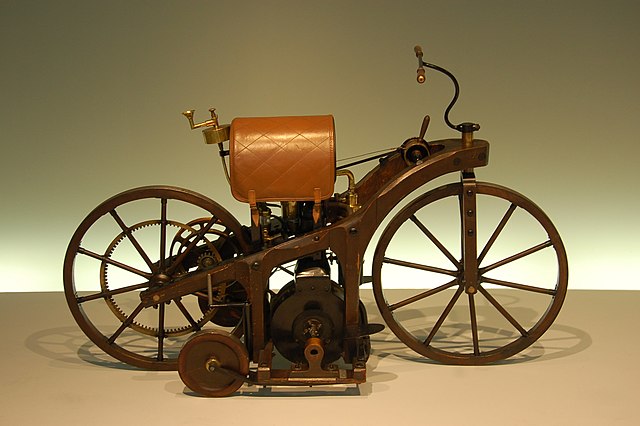
📷 Source · CC BY-SA 3.0

📷 Source · CC BY-SA 3.0


📍 Mercedes-Benz Museum, Stuttgart
🏆 The "First Motorcycle" Debate — Infographic
| Attribute | 🇩🇪 Daimler Reitwagen | 🇫🇷 Michaux-Perreaux | 🇺🇸 Roper | 🇮🇹 Bernardi Motrice Pia |
|---|---|---|---|---|
| Year | 1885 | c. 1867–1869 | c. 1867–1869 | 1884 |
| Engine | Gasoline ICE ✅ | Steam | Steam | Gasoline ICE ✅ |
| Wheels | 4 (+ outriggers) | 2 (true bicycle) | 2 (true bicycle) | 3 (tricycle) |
| Patent | DE 36423 ✅ | No. 83,691 ✅ | None ❌ | Yes ✅ |
| OED Definition | ✅ (ICE required) | ❌ (steam) | ❌ (steam) | ✅ (ICE) |
| Surviving? | Destroyed 1903 ❌ | Yes (Sceaux) ✅ | Yes (Smithsonian) ✅ | Unknown |
| Industry Impact | Inspired all ICE vehicles ⭐ | Low (no successors) | Low | Minimal |
✅ For Reitwagen as First
- First gasoline ICE motorcycle (OED definition)
- "History follows things that succeed" — Kevin Cameron
- Forerunner of ALL ICE vehicles
- Led directly to automobile industry
- Patent-documented (DE 36423)
❌ Against
- 4 wheels (outriggers) — not a true bicycle
- "Crude makeshift" — Burgess-Wise
- No rake/trail — 20 years behind bicycle design
- Never intended as motorcycle — just engine test bed
- Steam predecessors are 16–18 years older
"History follows things that succeed, not things that fail."— Kevin Cameron, Technical Editor, Cycle World
🔥 Fate & Replicas
The original Reitwagen was destroyed in the Cannstatt Fire of 1903 that razed the Daimler-Motoren-Gesellschaft Seelberg-Cannstatt plant. Several replicas (Nachbauten) exist worldwide, varying in which version they follow:
- Mercedes-Benz Museum, Stuttgart — primary replica (currently on loan to KTM Motohall, Mattighofen, Austria)
- Deutsches Museum, Munich — lent to Guggenheim Las Vegas "Art of the Motorcycle" (2001)
- Auto & Technik Museum Sinsheim
- Motor-Sport-Museum, Hockenheimring
- Verkehrsmuseum Dresden
- PS-Speicher, Einbeck
- Honda Collection Hall, Twin Ring Motegi, Japan
- AMA Motorcycle Hall of Fame, Ohio, USA — larger than original; uses 1884 design
- Deeley Motorcycle Exhibition, Vancouver, Canada
- GRIDX Centre, Wickrange, Luxembourg (2026)
🏛️ Gallery: Auto & Technik Museum Sinsheim


🏛️ Gallery: Motor-Sport-Museum, Hockenheimring


🏛️ Gallery: Verkehrsmuseum Dresden

📷 Source · CC BY-SA 4.0
🌍 Gallery: PS-Speicher, SATM, Memphis, GRIDX & Events
PS-Speicher Einbeck · SATM · Memphis · GRIDX · Classic-Gala · Retro Classics


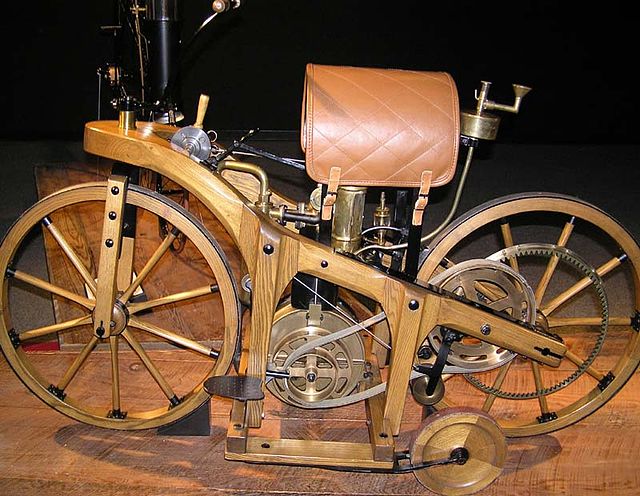


🔧 Gallery: Nachbau (Replicas)


📅 Infographic Timeline (1834–2026)
📖 Primary Scientific References
- Wikipedia — "Daimler Reitwagen." Link
- Wikipedia — "Gottlieb Daimler." Link
- Wikipedia — "Wilhelm Maybach." Link
- Encyclopaedia Britannica — "Gottlieb Daimler." Link
- Encyclopaedia Britannica — "Wilhelm Maybach." Link
- Mercedes-Benz Archive — "Gottlieb Daimler." Link
- DPMA (German Patent Office) — "Wilhelm Maybach." Link
- German Patent DE 36423 (29 August 1885) — "Petroleum Reitwagen."
- Kern Motorenmanufaktur — "Standuhr Engine Specifications." Link
- Jalopnik — "Daimler Granted Patent For Grandfather Clock Engine." Link
- Automotive History — "November 10, 1885 — The First Motorcycle Rider." Link
- Stuttgart Tourist — "Gottlieb Daimler Birthplace." Link
- Pierson, Melissa Holbrook — The Perfect Vehicle: What It Is About Motorcycles.
- Cameron, Kevin — Technical Editor, Cycle World.
- Burgess-Wise, David — Motoring historian.
- Setright, L.J.K. (1979) — The Guinness Book of Motorcycling. ISBN 0-85112-200-0.
- Wikimedia Commons — All images PD or CC licensed.
❓ Frequently Asked Questions
Was the Daimler Reitwagen really the first motorcycle?
By the Oxford English Dictionary definition (requires internal combustion engine), yes — it is the first gasoline ICE motorcycle. However, steam-powered two-wheelers (Michaux-Perreaux and Roper) predate it by 16–18 years. The Reitwagen also used outrigger wheels, making it technically four-wheeled.
Where can I see a Daimler Reitwagen today?
Replicas at Mercedes-Benz Museum (Stuttgart), Deutsches Museum (Munich), Auto & Technik Museum Sinsheim, Verkehrsmuseum Dresden, PS-Speicher Einbeck, KTM Motohall (Austria), Honda Collection Hall (Japan), AMA Hall of Fame (USA), and GRIDX Centre (Luxembourg).
Who rode the Reitwagen first?
Paul Daimler (age 17) made the official first ride on 18 November 1885. Maybach may have made earlier test rounds around the greenhouse. Paul's seat caught fire during the ride.
Why was it called the "Grandfather Clock" engine?
The vertical single-cylinder engine's tall, narrow profile with its large flywheel resembled a pendulum grandfather clock (Standuhr in German).
What happened to the original?
Destroyed in the Cannstatt Fire of 1903 that razed the entire DMG plant.
